
People Care About Spaces That Care About Them: Evolving Spatial Cultures of Indian Third Places
Dhanya Rajagopal is a Cultural researcher at LOCAL from Chennai, India based in Poland. She is a Participatory design-researcher and urban strategist who advocates for inclusive public spaces. She loves playing the guitar and collecting maps and is obsessed with the Beatles. Dhanya holds a masters in Urban Placemaking and Management from Pratt Institute, Brooklyn.

When I think about fictional third places that perfectly capture the idea of belonging, I think of Pop Tate's Chock'lit Shoppe from Archie Comics.
Pop doesn't mind teenagers being teenagers. He remembers their names, birthdays, and favourite milkshakes. He offers life advice. And when his diner struggles to stay open, the entire community of Riverdale rallies around him.
Over the years, I've been fortunate to experience similar neighbourhood relationships in unlikely places like the petty shop owner across the street in Chennai, who always keeps a plastic stool outside for anyone who wants to stop and read the newspaper. Or Papito, a Brooklyn bodega owner who maintains a shelf of second-hand books for anyone to borrow.
As a placemaker and design researcher, it has been a joy to work on projects that ask similar questions: What makes people return to a place – not simply as customers, but as a community?
By now, most people are familiar with Ray Oldenburg, the sociologist who coined the term “third place” in his 1989 book The Great Good Place.
Oldenburg described third places as neutral, informal gathering spaces – cafés, pubs, barbershops – where collective life naturally forms outside home and work. While his observations emerged from an American context, the idea continues to resonate across cultures.
India, however, has long nurtured its own versions of third places – spaces where public and private life comfortably blur, where strangers gradually become familiar. We know them by many names.
The katte in Karnataka.
The adda in Bengal.
The nukkad and charcha across North India.
The theru monai kadai in Tamil Nadu.
The neighbourhood tapri.
The chowk.
And sometimes, the kirana or barbershop.

Even our homes were once designed for serendipitous encounters. Goa's balcaos and Tamil Nadu's thinnais created opportunities for conviviality between neighbours long before "third spaces" became part of our vocabulary.
If India has always had rich traditions of gathering, why do third spaces feel more important than ever today?
A recent global study by JB.com ranked India as the world's second loneliest country, with 58% of respondents saying they feel lonely. Perhaps this is why we're witnessing a renewed interest in spaces that invite people to gather not through obligation, but through shared interests and everyday rituals.
Across India's metro cities, residents are opening up their homes and terraces to strangers. Reading circles, crochet clubs, film screenings, musical Sundays and collectives are finding new places to meet. These communities aren't simply looking for somewhere to spend time. They're looking for somewhere to belong. Even in an increasingly digital world, we continue to seek physical connections in shared places.
While our research drew from existing literature on third places, many new observations emerged through sensory walks and rapid ethnographic studies across Indian neighbourhoods.
Here are a few personal reflections.
1. Community forms at the neighbourhood scale.
Oldenburg describes third places as the social glue of healthy neighbourhoods. Our observations echoed this. The strongest relationships often emerged through repeated, everyday encounters rather than planned interactions. The neighbourhood is the scale at which stewardship is forged.
2. You can't manufacture genuine emotional connection to a place, but you can design subtle cues that encourage it
The most loved neighbourhood spaces rarely felt intimidating. Instead, they offered subtle invitations to participate.

A shaded verandah. A bench. A pot of drinking water.
A newspaper stand. A bookshelf.
A radio playing some old tunes at a tea stall.
A place to leave a note or scribble a thought.
These small elements encouraged interaction without demanding it.
3. Our social infrastructure thrives even where physical infrastructure falls short.
Even when public spaces lack investment, communities continue to create belonging. Sometimes, all people need is a gentle nudge. Urbanist Hans Karssenberg writes that for cities to build belonging and trust, they need to cultivate the orgware (caring for spaces) and software (social infrastructure), and not just the hardware (physical infrastructure). Third spaces could be that important thread, weaving these 3 layers together.

4. Indian third spaces comfortably hold contradictions.
As a generation, we have become accustomed to being both traditional and modern, quiet and expressive. Our third spaces increasingly reflect this duality. There is a demand for such places that can flexibly accommodate protests, celebrations, solitude and conversations, and space to simply be themselves or experiment with who they are.
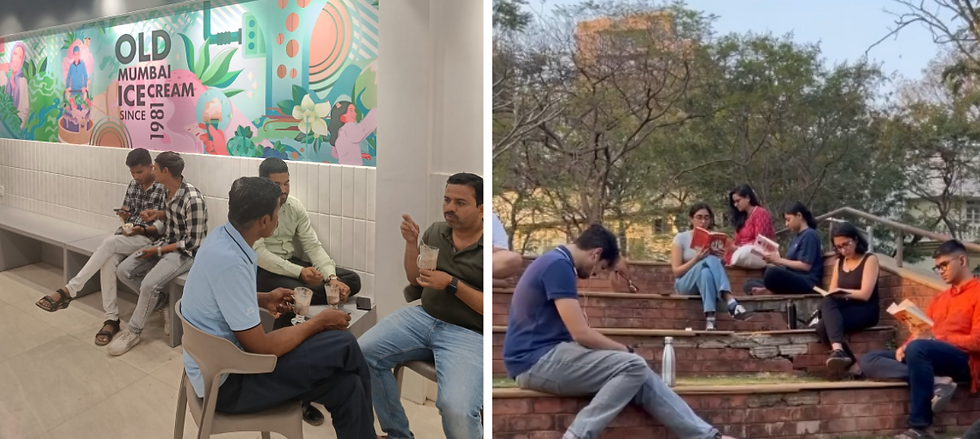
5. The greatest luxury is a place that asks only for your time.
Many of our most meaningful spaces allow people to simply exist without the obligation to spend money. Oldenburg described this as “neutral ground".
Yet today, we increasingly pay by the hour for leisure that was once freely available in our public realm – a reflection of the declining quality and accessibility of shared civic spaces.
6. India absorbs global symbols and makes them its own.
Across the country, global visual references are constantly reinterpreted through local culture. A tea stall in Anand, Gujarat, for instance, features mascots inspired by McDonald's iconography while remaining unmistakably Indian.

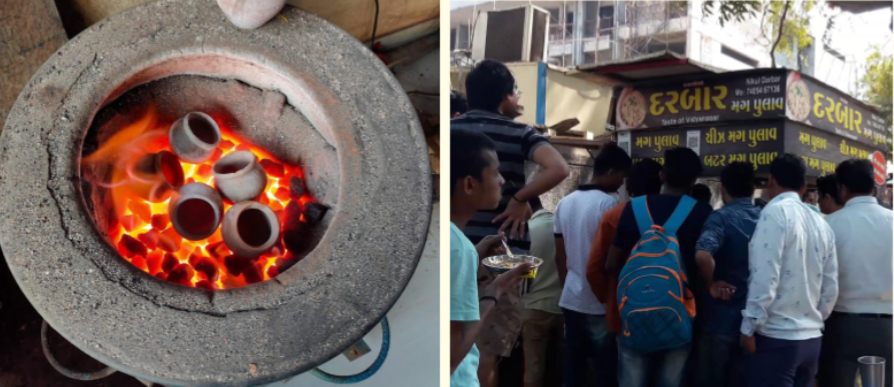
7. Street food creates theatre.
Many Indian third spaces are sensory experiences as much as social ones.
The sounds, smells, movement and performance of street food transform ordinary places into memorable communal rituals.
8. We still seek physical connection.
While laptops have become common in cafés and parks, our observations suggest that Indians continue to visit third spaces primarily to spend time with others rather than to be alone.

Perhaps that's what meaningful third spaces have always understood – people don't return because a place serves good coffee or occupies a convenient corner. They return because, over time, a place begins to recognise them.
Because ultimately,
people care about spaces that care about them.
Dhanya


Comments